Replace smoke alarms after 10 years, and where CO alarms go
Updated: 2 November 2026
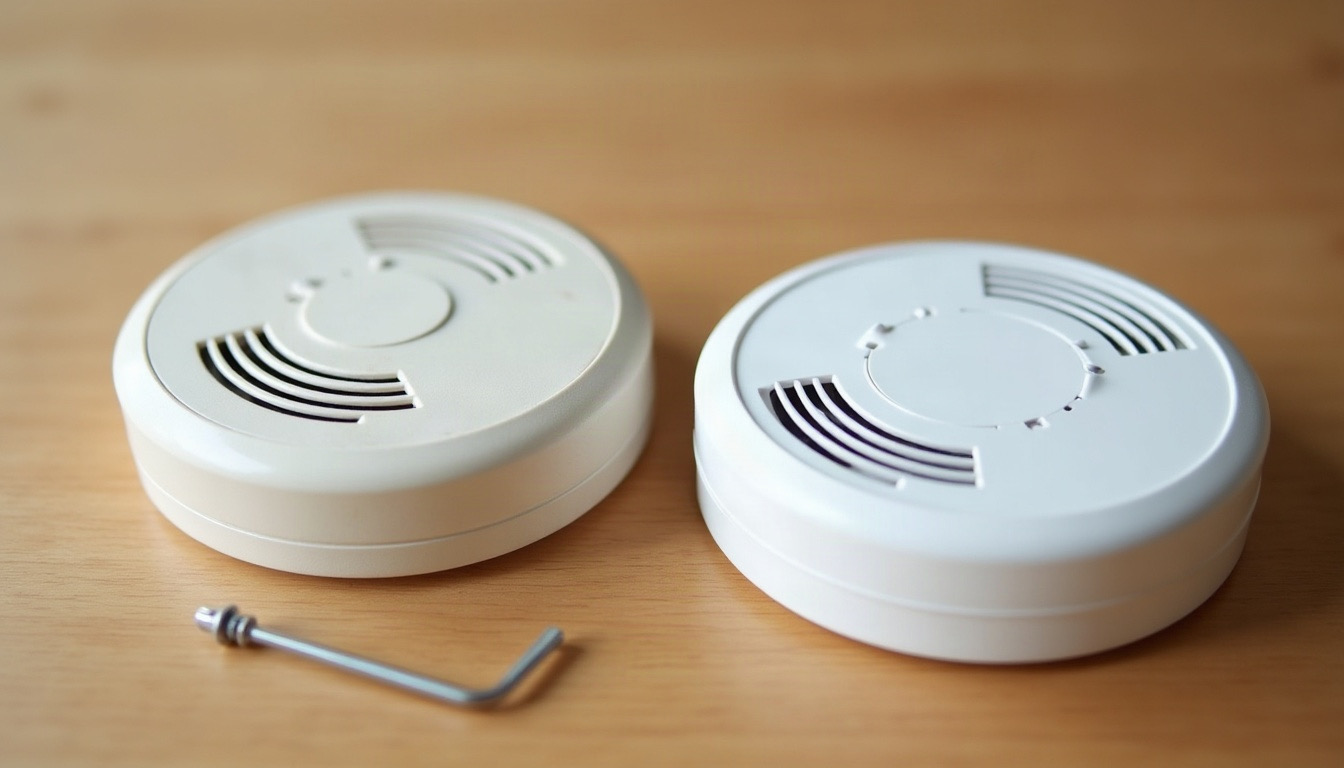
Smoke alarms often hang on the ceiling for so long that nobody remembers when they went up. They do not beep, so they must be working, you think. But a smoke alarm has an expiry date, and so does the carbon monoxide alarm near your boiler or stove. This article explains how to find that date, what to look for in a new alarm, and where a CO alarm should go. The rules differ per country; we give the Dutch, Flemish and French ones as examples. Is your alarm chirping right now? Read smoke alarm beeping first.
Why replace after 10 years?
According to the Dutch fire service, every smoke alarm needs replacing after ten years, whatever the type. The Flemish government also gives ten years as the maximum lifespan. The fact that an alarm still seems to work does not change that.
An alarm with a sealed ten-year battery therefore lasts exactly as long as the battery. When it runs out, the whole alarm goes.
Where is the date?
The Dutch fire service says: look on the bottom or side of the alarm. Twist it off its mounting plate to see it. You will find a production date or a replace-by date.
- Production date about ten years ago? Replace it.
- No date at all? Assume it is old, especially if it has yellowed or nobody knows who put it up.
When you fit a new one, write down the date, or add it to your household records. Then you will not have to search in ten years’ time.
Choosing a new smoke alarm
According to the Dutch fire service, look for three things:
- The EN 14604 mark. That is the European standard for smoke alarms.
- A battery that lasts ten years. Then you do not need to swap batteries in between.
- Interlinked alarms. If one goes off, they all go off. That way you hear a fire in the attic in the bedroom downstairs too.
A heat alarm is an addition for places where a normal smoke alarm gives false alarms. The Dutch fire service mentions one for the bathroom if there are appliances there that could cause a fire.
How many, and where?
Rules differ per country, so check with your national or regional authority. Three examples:
- The Netherlands: since 1 July 2022, a smoke alarm is required on every floor with a living room, bedroom or kitchen. An attic or cellar used only for storage does not count. The owner provides the alarms, so in a rented home the landlord does.
- Flanders (Belgium): since 1 January 2020 also required in owner-occupied homes, one on every storey. It must be an optical alarm meeting NBN EN 14604, and a sealed ten-year battery is recommended. In a rented home the landlord buys and fits them; with a replaceable battery, the tenant replaces it.
- France: every home must have at least one smoke detector, installed by the owner. One per floor is recommended in homes with several levels.
Where to put them? The Dutch government and fire service advise:
- On the ceiling, preferably in the hall and on the landing, on the escape route.
- At least 50 centimetres from a wall or corner, and 30 centimetres from a light.
- Not in a draught, not near vents and not near a heater.
The carbon monoxide alarm
You cannot see, smell or taste carbon monoxide (CO). It forms when fuel burns incompletely, for example in a gas boiler, water heater, gas fire, wood stove or open fire. A smoke alarm does not respond to it; you need a separate alarm.
Required? It depends on the country. In the Netherlands it is not mandatory: according to CO-wijzer, the site the Dutch government refers to, a CO alarm is not compulsory but strongly recommended. The Dutch fire service advises one at least in the room with the heating appliance or the open fire.
Where to put it? The Dutch fire service’s placement advice:
- In the room with the fuel-burning appliance: on the ceiling, central in the room, 1 to 3 metres horizontally from the appliance and at least 30 centimetres from the walls. On a sloping ceiling, fix it to the sloping part.
- In a bedroom: at breathing height, the height at which you sleep.
- In other rooms: at the breathing height of what you do there, sitting or standing.
- Never: next to a vent or air outlet, behind a cupboard or curtain, or directly above a hob.
If your alarm’s manual says otherwise, follow the manual or ask the supplier.
Which alarm? Buy only an alarm with EN 50291 on the packaging, preferably one that lasts 5 to 10 years, says the Dutch fire service. Write the fitting date and the replace-by date on the front with a permanent marker.
Combined alarm? One device for smoke and CO. The Dutch fire service only recommends it if it hangs in the room with the fuel-burning appliance. Elsewhere, a separate smoke alarm and a separate CO alarm, each in its own place, is the better choice.
It goes off? Warn everyone at home, get outside as quickly as possible and call the emergency number (112 across the EU), says the Dutch fire service.
A CO alarm does not replace servicing your appliances. Have them checked regularly by a qualified professional; the Dutch fire service advises yearly. If you burn wood, also read how often to sweep your chimney.
Testing, in between
Ten years is a long time. In between, the Dutch fire service advises: test every month with the test button and keep the alarms free of dust, because dust can cause faults and false alarms. A CO alarm you check according to the manufacturer’s manual.
How Domeaz helps
Add your smoke alarms and CO alarm to Domeaz as appliances, with their place in the house and the date you fitted them. Then set up two tasks as recurring maintenance: “Test smoke alarms” every month, and “Replace smoke alarms” in ten years. You get a reminder by push notification and email in advance, and see who at home is taking care of it. When you tap “Done”, note what the new alarms cost; that goes into your cost overview.
What else to sort out before winter is in getting your home ready for winter.
The free version of Domeaz is fully usable, with no ads and no trial period. Discover Domeaz.
Frequently asked questions
- How long does a smoke alarm last?
- Ten years. According to the Dutch fire service, every smoke alarm needs replacing after ten years, whatever the type. The date is on the bottom or side of the alarm.
- Where is the date on a smoke alarm?
- On the bottom or the side, according to the Dutch fire service. Twist the alarm off its mounting plate to see it. It is usually a production date, sometimes a replace-by date.
- Is a carbon monoxide alarm required by law?
- It depends on the country. In the Netherlands it is not mandatory, but strongly recommended. The Dutch fire service advises at least one in the room with the heating appliance or the open fire.
- Where should a carbon monoxide alarm go?
- According to the Dutch fire service: in the room with the fuel-burning appliance, on the ceiling, 1 to 3 metres horizontally from the appliance and at least 30 centimetres from the walls. In a bedroom at breathing height, the height at which you sleep. Never directly above a hob or next to a vent. Follow the manual if it says otherwise.
- How long does a carbon monoxide alarm last?
- It varies. The Dutch fire service recommends buying one that lasts 5 to 10 years, and writing the fitting date and the replace-by date on the front with a permanent marker.
Sources
- Dutch fire service: smoke alarms
- Dutch government: how many smoke alarms do I need?
- Dutch fire service: carbon monoxide
- Dutch fire service: where to put a carbon monoxide alarm
- CO-wijzer (Netherlands): questions about carbon monoxide alarms
- Flemish government: smoke alarms
- Service-Public.fr: smoke detector in the home
This article was written with the help of AI and checked by the Domeaz team. The sources are in the text. Spotted a mistake? Email hello@domeaz.app.